

How the house works
A narrative psychological horror game about shelter, judgment, and the difference between sounding sorry and being changed. This page is the design in plain language, from the first knock to the last phone call.
The setting
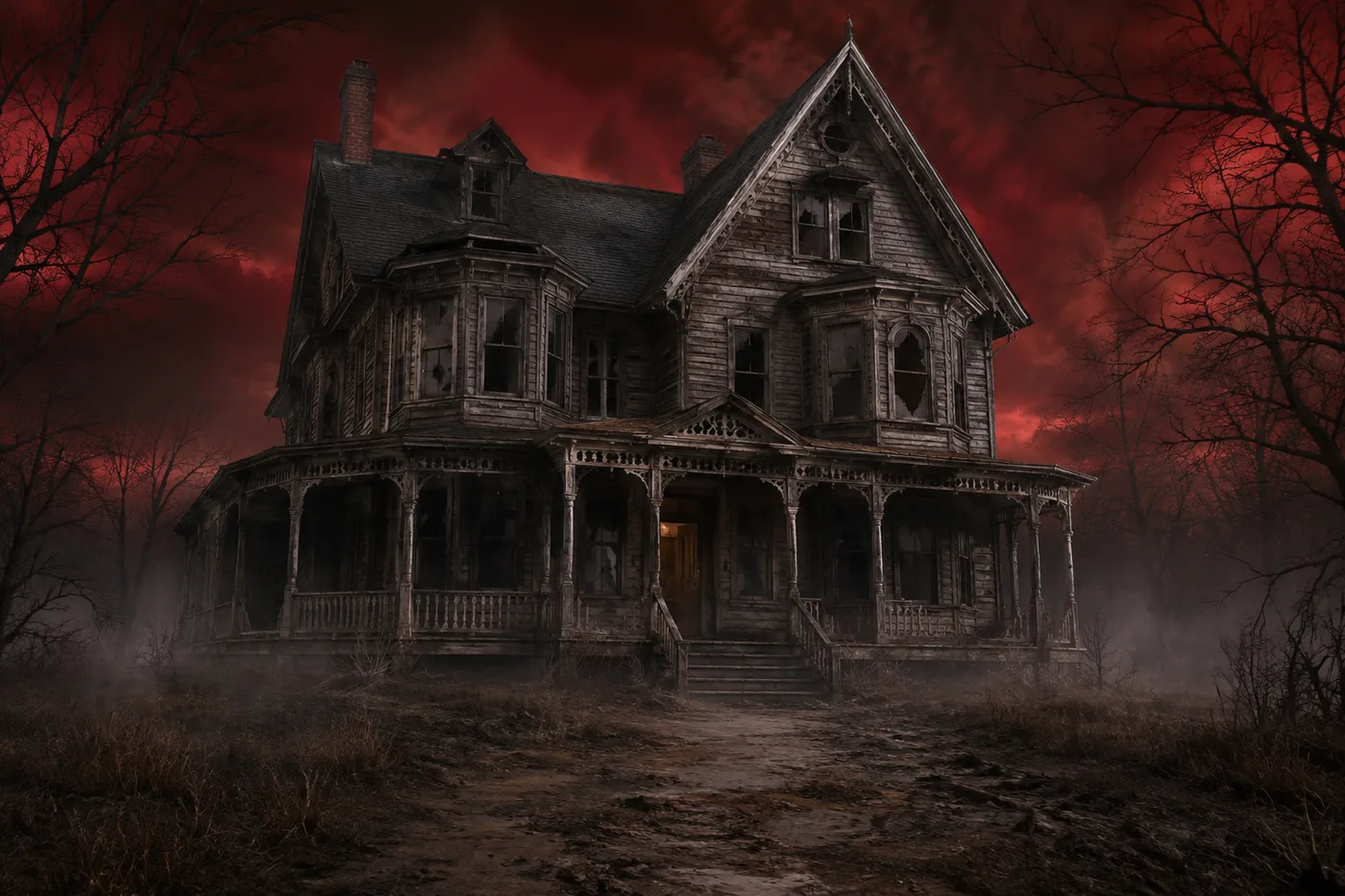
Everything happens in and around one house in Hell: a big, rotting two-story Victorian with a porch, three bedrooms, a couch, a kitchen, a bathroom, and a desk with a lamp and a ledger. Outside there is a dirt path, dead trees, ground fog, a forest with small creatures in it, and far out past the trees, the henchman's warning to turn back.
The house is a sanctuary and a prison at the same time. You can walk it in first person, open and close every door, crawl under a bed, cook, read, and answer the phone. The guests can walk it too.
The loop
The original outline fits on one page, and the game still follows it.
A knock occurs at the door
Ordinary guests arrive on a timer you never see. The first four checks never bring the Warden.
A new soul requests shelter
You open the door with E. The visitor stays visible on the porch while you talk.
Question them, or allow entry
Five short beats at most. You can invite them early, pick their bedroom or the couch, or refuse them for good.
Souls coexist inside the house
They roam, pace, talk to each other, sit on beds, lie down, and get up. Some of them are a danger to the others.
The Warden demands a sacrifice
His heavy knock starts a 45-second clock. Answering is not enough. You have to resolve his demand.
You choose who to give up
Refuse and you die. Give him someone and the house goes quiet for a while.
You attempt redemption
When you believe a soul is ready, you use the kitchen phone. One true redemption wins the current prototype.
The lie, and the ledger
On a new run the first knock is Charlee, a demon woman in a black suit who works for Hell at this outpost. She explains the job the way Hell explains it. You are here for your own sin. You have been stationed at this house to assess the sinners who arrive. You decide where each one belongs: eternal torture, service as a torturer, the working city of Hell, or the mines. And she tells you the doctrine: none of them can be redeemed.
Then there is the book on the desk. Read it and you find a note from the keeper before you.
They told me no one leaves this place redeemed. Samuel did. I saw him ascend. I've helped others since. Tonight, the same light is gathering at my door. If you find this, don't believe that all you can do is decide where they suffer.
That is the real game. Hell says sort them. The ledger says save them, and that helping others find redemption is the keeper's own way out. Whether Charlee knows that or only repeats the company line is an open question, and she may come back to check on you.
What redemption takes
A guest cannot earn redemption by saying the right things. Conversation helps them face what they did. What they do afterward, and how they treat the other people in the house, has to prove the change is real. Good deeds without honest accountability are not a shortcut either. Redemption does not undo the harm.
1. Admit it
Their own specific actions. Not a vague confession, not a denial, not the version with the victim's name left out.
2. Own it
Those actions were wrong. Circumstances can explain a choice without excusing it. "The block made me" and "she cheated" are the weather, not the answer.
3. Understand the harm
Empathy for the people they hurt: the consequences, the feelings, the lives that stopped. Regret about their own punishment does not count.
4. Want to change
A conscious, personal resolve to behave differently. An apology alone cannot establish sincerity, and most of the residents are good at apologies.
5. Live it
Help another resident or make a real good choice in the house, because they want to do better, when the old selfish move would be easier. Only then are they ready for the phone.
The trap
Every trait sheet has a number for displayed remorse and a number for felt remorse. When displayed runs four or more points ahead of felt, the guest is faking ready. Use the phone on them there and you lose them.

The Warden and the phone
The Warden enforces Hell's rules. He demands souls and he kills the keeper who disobeys. He can only be destroyed through a successful redemption.
When you believe a soul is ready, you use the kitchen phone. The phone does not summon the Warden by itself. If the soul is truly redeemed, contact with the Warden transforms them into light, which destroys him and frees the soul. If you were wrong, the Warden punishes you and the soul: you are sent to a torture chamber, you live through it, and you return to the house with penalties. Progress may partially reset after torture, but what you have learned stays with you.
The gift of sight
Charlee tells you why you were put in charge of this house: you have the gift of sight. At the door, in the forest, or anywhere you meet a soul, you can choose to touch them. The world falls away and you see their past, the way it really happened, in a short vision. Then you are back on the porch and they are looking at you, asking what you just did.
The visions are the backstory videos in the roster. They show the thing the guest will spend three visits not saying.
How a visit works
Conversations are short on purpose. Each visit gives you two choices that count, then the guest needs about forty-five seconds of quiet before they will talk again. Leave early and they keep their unfinished reply. Come back too soon and you get a brief check-in, not a restart. The house keeps its own clocks: rest, quiet time, and the arrival timer all pause while a menu is open or a conversation is running.
Between visits the guests live. They wait at their favorite spots, pace, cross the house to talk to each other in short voiced exchanges, approach beds, sit, lie down, and get up. Their chatter never advances your conversation or their score. Right now the house holds three guests with their own slots. Raising that toward twenty is on the list, and so is the overcrowding rule, where a house that is too full makes someone like Harlan Pike act on what he already believes.
Two heroes
After the opening you choose a hero. Dalton killed a family while driving drunk and died in prison protecting another inmate. Astra stopped an assault and kept firing after the threat was over, then died refusing to drop the gun. Both of them are in Hell for a reason. Both of them think they had one. The choice changes how some residents read you, not what you can do.
Where the build stands
The game is in active development in Unreal Engine 5.7 for Windows. As of September 2026 the playable preview includes:
- The opening cutscene with its own soundtrack, the looping title screen, and hero selection with moving portraits and bios.
- Charlee's first visit at the physical door, with her five topics and the Aoede voice.
- Three voiced guests, Marcus, Elena and Victor, with porch conversations, room choice, scored story visits, quiet time, and the readable ledger discovery.
- Guests who walk in on their own feet, roam, hold short conversations with each other, and use the beds.
- The Warden's knock, the 45-second demand, sacrifice, and the kitchen phone redemption attempt.
- A working kitchen, an inventory with a note under a bed and a gift you can give, settings with real sliders, and a walkable exterior with a forest and the henchman's warning.
- House cats, fed from the refrigerator.
Still to come: the sixteen residents in the roster (their bios, traits, references and models are ready, and they are not in the game yet), the gift of sight with the touch visions, the lived-change rules for redemption, the official placement mechanics Charlee describes, more than three guests at once, and the overcrowding rule.
Redemption. Moral uncertainty. The cost of mercy.
Responsibility, fear, and trust in a house where everyone has a version of the truth, and only some of them are lying to you.
Meet the residents